I'M BAAAAAAAAAAAAAAAACK ...


  Yes, I'm still here. I won't make excuses or explanations for the absence but will hopefully be back and posting again ...

  This story inspired me to chime in, especially as we're right in the middle of pre-draft-mania and the tournaments leading up to the College World Series. (Wish I could be in Chapel Hill this weekend for the super regional between host North Carolina and East Carolina ... I could call it the Aunt Bowl in honor of my daughter, whose aunt on one side lives right outside of Chapel Hill and whose late aunt on the other was an esteemed professor at ECU before she passed away in 2006).

  Anyway, the story linked is about a high school playoff game in Minnesota where both starting pitchers threw more than 200 pitches. Sounds impossible to fathom in this world of pitch counts where an outing of more than 100 pitches borders on abuse.

  But it brought back memories of the first college post-season series I ever covered as a sportswriter, the first time I went on the road, the first time I felt a part of baseball writers' press box camaraderie, and the week I realized yes, this is what I want to do.

  The year was 1988. The place, Beehive Field in New Britain, Connecticut.

  The event: The ECAC (East Coast Athletic Conference) tournament, the winner of which would move on to the Northeast Regional tournament, which would also be held at beautiful (not) Beehive.

  I was there to cover the Fordham Rams, the MAAC champions.

  Although the paper for which I was working covered Fordham regularly during both football and basketball season, it pretty much ignored all college baseball teams. But the Rams were really good, even with the loss of their 1987 ace Pete Harnisch, who had been a first-round pick by Baltimore in the previous year's First Year Player Draft.

  Perhaps their best player was a freshman outfielder named Ray Montgomery who had a school record 21-game hitting streak and earned Co-MAAC Player of the Year honors. He went on to play in the big leagues and is probably too busy this week to read this blog entry since he's the Assistant Scouting Director for the Milwaukee Brewers (but I bet he'd remember the game). (Here he is with MLB Network star Matt Vasgersian at a Triple-A All-Star Game back when they were both up-and-coming future stars). 
Matt Vasgersian and Ray Montgomery.jpg
  So since I wanted to be a baseball writer and was getting basically NO opportunity to do at that time at that job, and since Fordham really deserved someone covering them through the post-season, I volunteered to become their beat writer on my own time and my own dime. I guess the price was right because they let me do it.
 
  Also in the tournament were Hartford, featuring slugging third baseman Jeff Bagwell (the scouting report on him was pitch him inside), Maine with a freshman outfield sensation named Mark Sweeney, LeMoyne (their ace was a kid named Peter Hoy who made it briefly to the big leagues), C.W. Post and Fairleigh Dickinson University, aka FDU and aka a big rival of Fordham.

  I was all eager beaver reporter armed with my scorebook and about 82 pens (some things never change), assiduously writing down not just every play made but every pitch thrown.

  It was the Rams' second game of the tournament and their first against FDU where that habit almost caused carpal tunnel syndrome.

  On paper, it was just your typical garden-variety 14-inning game (the Rams would go on to play a 19-inning game against Clemson in the first round of the Northeast Regionals later that week), which Fordham lost, 6-5 (they would come back to beat FDU the next day by the same score).

  Neither team had lost yet in the double-elimination tournament so while the stakes were high, they weren't THAT high.

  Fairleigh Dickinson sent its ace to the mound, a sophomore right-hander named Mike Mongiello who was their conference's Player of the Year that year. And he pitched like an ace for nine innings.

  When he came out for the 10th inning, the reporters all glanced at each other in surprise.

  When he came out for the 11th inning, I counted my record of all the pitches he'd thrown. I don't remember the total at that point but it was really high.

  In the 12th inning, the "official" pitch count for Mongiello, who was still in there, was relayed up to the press box from the FDU dugout and let's just say it was significantly lower than the number indicated in my scorebook. And while I may have MISSED a few pitches, I certainly hadn't ADDED 20.

  Mongiello remained in the game for the 13th and 14th innings and finally came away with the complete-game win in an absolutely masterful and gutsy performance.

  FDU's official pitch count for him was 215 pitches. That is what I wrote in my story. My scorebook showed 250 pitches. That didn't include warmups between innings and may have missed a few full-count foul balls.

  Mongiello went on to be drafted in the seventh round of 1989 by the Chicago White Sox and enjoyed a seven-year Minor League career with them, getting as far as Triple-A and posting a 3.64 ERA.

  Our paths crossed in the Minors a few years later and of course I had to go over and introduce myself and tell him that I had been there for that amazing game.

  Apparently he must have told some of his teammates about it and no one believed him, or at least thought he was exaggerating. I was able to not only confirm the epic outing, but add that in fact his own telling of it with a pitch count of 215 wasn't giving himself enough credit.

  He obviously had no hard feelings about the workload either, because he spent some time later on at FDU as their assistant pitching coach. I'm guessing, though, that he never left one of his pitchers in to throw 250 pitches.


BASEBALL HONEYMOON PLAYS NOSTRADAMUS FOR 2009!

Opening Day (or as many of us say OPENING DAY!!!!) is here in the Majors, and Opening Day (or OPENING DAYS because for some reason the Eastern League is starting a day early) is almost here in the Minors ...

So Episode 7 of BASEBALL HONEYMOON brings you two awesome season previews for the price of one, as in ... well, as our blog says,

"the same low, low price of....of ..ABSOLUTELY NOTHING! FREE! GRATIS, BABY!"

bballhoneymoon2.jpg

For those of you, like me, who can't get enough of USA Today/Sports Weekly baseball guru PAUL WHITE talking baseball, the first half of the show is for you as he (and we) talk about our picks to win each division and each league's "big" awards (MVP, CY and Rookie of the Year).

The second half ... well, let's put it this way ... if you are one of the hundreds of people who have told me over the past year or two how much you miss the good old days when JONATHAN MAYO and I did our regular hour-long show "Around the Minors," consider this sort of a reunion show. It's not an hour (well, not quite) but we'll share our pre-season predictions for Minor League Player and Pitcher of the year ...


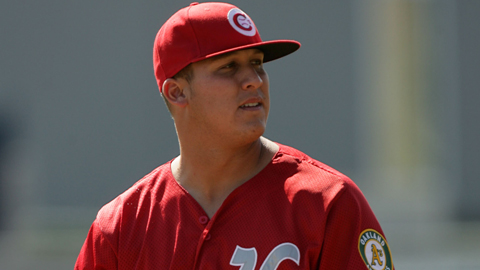
BEYOND THE BOXSCORE ... GETTING TO KNOW CINCINNATI REDS P JUANCARLOS SULBARAN

 Team Netherlands was the talk of the World Baseball Classic. 

  19-year-old pitcher Juancarlos Sulbaran was the talk of Team Netherlands.  And yes, it's spelled "Juancarlos," one word.

  I don't know about the rest of you, but watching this guy pitch in the game against Puerto Rico was one of the highlights of that tournament for me. I already knew a lot of the veteran players and coaches (hi Bam Bam! Hola Sir Eugene!) but was unfamiliar with Sulbaran.

  However, since I was working on the Cincinnati Reds organization preview at the time, I definitely took notice. In fact, I think I looked like one of those cartoon characters whose eyes pop out of their head (lovely image, no?).

  Sure, he finished the tournament with the highest ERA of any of the 13 pitchers on that impressive Dutch staff, allowing three runs total in 2 2/3 innings over two appearances. 

  But you can't expect a teenager who has yet to make his pro debut to dazzle while facing Major League stars.  

  Or can you? 

Juan Carlos in action.jpg  Sulbaran, Cincinnati's 30th round pick in 2008, made quite a World Baseball Classic debut when he came out of the bullpen in the sixth inning against Puerto Rico in a first-round game. 

  Inheriting men on first and third with two outs and a 1-0 lead, the first batter he faced was Ivan "Pudge" Rodriguez, a free agent who was showcasing his hitting skills.

  Sulbaran struck out Rodriguez on three pitches. 

  "When I came out of the bullpen I didn't know I was going to face him, I just knew that there were men on first and third and everyone in the stands was screaming," he recalled. "Then I saw him standing there so I just focused on my catcher and didn't think about anything else."

   One inning later, after loading the bases on a double, a single and a hit batter, he got out of the jam by getting Carlos Beltran to ground out to end the inning. 

  So who is this kid anyway? 

  The Curacao-born Sulbaran was impressive enough in his home country in his teens that teams began approaching him to turn pro. But his dad, Jorge, had other ideas. 

  "I was 16, before my junior year in high school, and my dad didn't feel I was ready to go and play and live by myself," Sulbaran explained. "So instead we moved to Florida so I could finish high school there and then get drafted."

  The Sulbaran family moved to the Miami area in 2006, where he attended American Heritage High School, a team that featured such talented classmates as first baseman Eric Hosmer, the third pick overall last spring by Kansas City, and catcher Adrian Nieto, the Nationals' fifth-round selection. 

  Sulbaran, honored as the Miami-area pitcher of the year for 2008, fell to the 30th round due to his commitment to the University of Florida but the Reds eventually signed him  with a $500,000 bonus, a record for that round. 

  Not that Sulbaran was idle that summer. Having caught the eye of the Dutch Olympic team's coaches during an earlier international tournament  when he limited the opposing club from Cuba to one hit over seven innings, he was invited to join the squad and pitched for Team Netherlands in Beijing. 

  In the Olympics, he once again faced Cuba, this time a slightly older and more experienced squad, allowing two earned runs over 4 2/3 innings in a loss to that squad. 

  And that showing pretty much wrapped up his invitation to join the World Baseball Classic squad where, once again, he was the youngest member of the team , three weeks younger than fellow pitching phenom Dennis Neuman of the Red Sox. 

  While both experiences were rewarding in their own ways, Sulbaran thinks the World Baseball Classic may have been more educational. 

  "In the Olympics, there were fewer professional players and they weren't at as high a level as the players in the World Baseball Classic," he said. "Pitching there, any mistake you made, you pay for it."

  Sulbaran, whose repertoire includes a hard sinker, a good curveball and a changeup, remains in Reds camp in Sarasota nursing a blister which will likely push his pro debut back a bit longer, until he can go six or seven innings. 

  He can't wait till he can get out there and officially start his pro career, expected to be at Class A Dayton, but don't think that facing Midwest League batters will change his game plan. 

  "It doesn't matter who you're facing, if I make a mistake they'll hit me the same way," he said. "So I just have to focus on keeping my pitches down and staying ahead in the count, whether I'm facing a rookie or a Hall of Famer."

  Our "Beyond the Boxscore" interview was shorter than usual because of technical issues (don't you hate excuses like that) and also because I couldn't ask him some of the usual questions about his minor league career thus far, but I am really hoping to get the chance to cross paths with him this season, watch him pitch again, and do a more in depth interview.


MLB: Of what accomplishment, on or off the field, in your life are you the proudest? 
Juancarlos Sulbaran: Finishing high school. In Curacao, everyone leaves school when they're 15 and never finishes high school. Now that I've graduated, I'm really glad that my dad made that decision for me. 

MLB: What do you think you'd be doing now if you weren't playing baseball? 
JCS: Probably working with my dad for his contracting company. 

MLB: Everyone has a "hidden talent." What's yours? 
JCS: I have soccer skills. 

MLB: Do you have other hobbies or creative outlets aside from baseball?
JCS: I like watching movies, playing soccer, and just hanging out with my friends. 

MLB: Complete this sentence: It would surprise people to know that I...
JCS: Don't like pitching that much! I was a first baseman and third baseman. And for me, baseball was always more about how to get on base, steal a base, slide, get dirty and make diving catches. But I'm learning more about pitching now. 

MLB: Who is the most unusual character you've met in your pro baseball career?
JCS: (Dutch teammate pitcher) Sidney Ponson. Whateer he says, whatever he does, it always makes you laugh. 

MLB: If you were commissioner for a day, which one rule would you change? 
JCS: Let all the pitchers hit! 


BEYOND THE BOXSCORE ... GETTING TO KNOW HOUSTON ASTROS OF JOHN GALL

Once you meet veteran outfielder John Gall, you may never listen to Guns N' Roses the same way again (that is, of course, if you listen to Guns N' Roses). 

  Gall, currently in the Houston Astros system, uses the hard rock band's first hit, "Welcome to the Jungle" as his "walk up" music when he comes to the plate.

John Gall by Carl Kline.jpg  Not because he's such an Axl Rose fanatic, but rather because to him the song says: "Welcome to the John Gall."

  This spring Round Rock Express fans will be welcoming Gall to town and will be treated to that song each night, as Gall's .375 average in 16 spring training games as a non-roster invitee were not enough to crack the Houston opening day roster. 

  Express fans are probably already familiar with Gall, since he hit .357 with two homers and 12 RBIs against the club last year while with the Albuquerque Isotopes. 

  In fact, he's been something of a staple in the Pacific Coast League for several years now. 

  Originally signed out of Stanford University in 2000 by St. Louis as an 11th-round pick, Gall moved quickly through the Cardinals' Minor League ranks, reaching Triple-A Memphis by 2003. 

  Gall, who will turn 31 this week, has batted .298 over nine Minor League seasons with five .300-plus summers. 

  But despite posting consistently strong numbers across the board, and hitting a combined .292 over four seasons with the Redbirds, he only got a brief taste of big league time. In 22 games up in his 2006 debut he hit .270 in St. Louis, and got a 12-at-bat sniff the next summer. 

  Gall was granted his release by the Cards in July 2006 to sign with the Lotte Giants of the Korean Baseball League, adding international play to his resume. >

  He also gained a huge measure of respect for how that country went about its baseball business, enough so that he was not at all surprised by Korea's recent success in both the Olympics, where they won the gold medal, and the World Baseball Classic, where they fell to two-time champion Japan, 3-2, in 10 innings in the title game. 

  "I told one of my buddies that either Korea or Japan would come out on top," Gall said. "The Korean team is full of talent and has been able to play together in multiple tournaments. Familiarity with your teammates and coaches helps quite a bit during international play."

  Gall also enjoyed watching one of his old teammates, first baseman/DH Dae Ho Lee, nicknamed "Big Boy," in the WBC. 

  "He's one of the best hitters I've played with and an even better guy," Gall said. "I couldn't help but root for him during the tournament."

  Gall couldn't root for "Big Boy" quite as enthusiastically in the Olympics, however, since he himself was playing for the bronze-medal winning US Olympic Team in Beijing (the US lost to Korea, 8-7, in their lone head-to-head game). 

  "The Olympics was the best sporting experience I've ever been involved in," he recalled. "Imagine the electricity of a World Series Game 7 everyday for over three weeks. The intensity was there during every pitch"

MLB: Of what accomplishment, on or off the field, in your life are you the proudest? 

John Gall: My family. Happiness is at home with my wife and son. A cliché, but true.

MLB: What do you think you'd be doing now if you weren't playing baseball? 

JG: I'd be broke somewhere in mid-town Manhattan wondering what just happened.

MLB: Everyone has a "hidden talent." What's yours?   

JG: Weatherstripping. No heat escapes my house in the winter!!

MLB: Do you have other hobbies or creative outlets aside from baseball?

JG: I love cooking. I spend hours reading cookbooks and working my own recipes, rubs, etc. 

MLB: Complete this sentence:  It would surprise people to know that I ... 

JG: Drink five cups of coffee a day. 

MLB: What is the worst job you've ever had?

JG: Changing diapers.  

MLB: What is your guiltiest TV pleasure?

JG: "Gossip Girl." I'm a member of the Chuck Bass fan club.

MLB: What reality TV show would you kick butt on?

JG: "The Apprentice."

MLB: If you could trade places with one person for a day who would it be and why?

JG: (Houston Astros GM) Ed Wade. So I could put myself on the Houston Astros 25-man roster.

MLB: Who would play you in the movie of your life?

JG: Mark Ruffalo.

MLB: Which aspect of life in the minors has surprised you the most, in comparison to what you might have imagined before you turned pro? 

JG: The brutal nature of the business. Good players have their dreams crushed in a very casual manner. Sometimes guys that could have been productive big leaguers get pushed out. I feel lucky to have played as long as I have. 

MLB: On your most recent club (Albuquerque Isoptopes), what was your favorite thing about playing there? 

JG: We had a great group of guys. Somewhere on the internet you can find some ridiculous videos of John Baker, Tagg Bozied, myself and others re-enacting movie clips. 'Topes Cinema. 

MLB: In your career, what has been your favorite road trip and why? 

JG: I like going to Salt Lake City to visit my good friend's bar and restaurant, Lumpy's. And both the city and ballpark are picturesque.

MLB: What is the best minor league promotion or visiting act you've seen? And the worst?

JG: The best promotion ever was the "Gall-mobile" during the 2002 season in New Haven. Somebody won my 1984 Cadillac El Dorado with the $2 purchase of a foam ball. What a deal! And the worst promotion I've ever seen was also the "Gall-mobile." I think I signed some stinky cleats and game balls and threw 'em in the trunk.

PHOTO COURTESY OF CARL KLINE/MiLB.com!


BEYOND THE BOXSCORE ... GETTING TO KNOW OAKLAND ATHLETICS 1B SEAN DOOLITTLE

  The odds are good that Oakland Athletics first base prospect Sean Doolittle hasn't had to spend much money lately on new batting gloves or sweatbands. 

  Like most ballplayers, Doolittle admits to having his share of superstitions and, again like most ballplayers, those often center around "lucky" apparel or equipment. 

  "As soon as things start to go downhill, I'll switch it up," explained Doolittle, whom the Athletics drafted out of the University of Virginia with a supplemental first-round pick in 2007. "Even my batting gloves and sweatbands are subject to change because obviously they've run out of luck."

  But since signing with Oakland in June 2007, those slumps have been few and far between. 

  In 2008, his first full season, the left-handed hitter combined between Advanced A Stockton and Double-A Midland to hit .286 with 22 homers and 91 RBIs before batting .293 in an Arizona Fall League stint. 

  It's looking like the As' decision for him to focus on offense over pitching was the right one. 

  A star pitcher and top hitter in high school, a large part of the reason Doolittle opted to attend Virginia was the school's willingness to let him see time as a two-way player.

  "By my third year there. with the draft in the near future, I decided that I didn't want to make the decision -- I wanted whomever drafted me to choose," he said. "It was too difficult a decision to make on my own!"

  He admits that, especially when he began his pro career, the little pitcher in his head would talk to him when he was at the plate. Sean by Paul Gierhart.jpg

  "The further I distance myself from my past on the mound, the less and less it happens," he said.  "When it does though, I have to ask for time and reset my brain.  It seems to work better when I don't think as much!  The less I guess or try and anticipate a certain pitch sequence and the more I simply react to what's being thrown, the better chance I give myself to have a quality at bat."

  His recent big league spring training appearance saw him bat .357 in 18 games, leaving a good impression before being reassigned to Minor League camp. 

  By the way, is it just me, or has anyone ever seen Doolittle and Cleveland Indians first base prospect Jordan Brown in the same place at the same time? This picture of Doolittle, taken by Paul Gierhart, is on the top. The one below it is of Brown, taken by Michael Janes. I think they look like they could be brothers. Very good-looking brothers, of course.

  And coincidentally, both happen to be terrific former journal keepers for MLB.com and, in fact, Doolittle is one of our Minor League bloggers for 2009 ... you can read his blog here when he starts keeping it when the season gets underway!


Jordan by Mike Janes.jpg MLB: Of what accomplishment, on or off the field, in your life are you the proudest? 
Sean Doolittle: I've been lucky enough that I've had a lot of things in my career of which I'm very proud.  My career at UVA, getting drafted by the A's in '07, representing my country on the baseball field for two summers during college.  However, two accomplishments standout for me personally.  In 2004, my high school won the state title and I racked up 23 K's in our extra inning state championship game.  And in the summer of 2006, I was a member of the National Team that earned a gold medal in the World University Games in Havana, Cuba.

MLB: What do you think you'd be doing now if you weren't playing baseball? 

SD: I think right now I'd be in school, finishing up my Psychology degree, figuring out exactly what I wanted to do.  However, I'm fairly certain I'd stay in the game as a coach, probably on the college level.  

MLB: Everyone has a "hidden talent." What's yours? 

SD: Ok, I don't know a foreign language.  I don't know any magic tricks.  I'm a pretty simple guy, out of the what you see is what you see is what you get mold.  I can read music and can dabble on the piano and I have a drumset at home and I can handle myself on that, although I'm no Stewart Copeland.  I'm pretty good with words too...as long as they're on paper.  I've always done well with anything that had to do with putting thoughts and pictures into words, and wouldn't mind making a living doing something related to that someday.  Maybe that's how I should have answered your previous question!

MLB: Complete this sentence: It would surprise people to know that I... 

SD: ...lived in California between the ages of 3-6 and spent my summers driving to Oakland where we had season tickets to Oakland A's games.  It was my first exposure to baseball as a little kid so it's really cool how things have (almost) come full circle.  

MLB: What is the worst job you've ever had? 

SD: The summer after my freshman year in high school I got a job at my middle school with a buddy of mine working on the maintenance staff.  We did everything - mopping floors, painting walls, replacing light bulbs, moving furniture.  My parents made me get a job, but that was miserable.  I've stuck to given lessons ever since!

MLB: What is your guiltiest TV pleasure?

SD: If "Friends" or "Seinfeld" is on TV, I'll put the remote down, even if I've seen the epidodes already.  But I'm cranky if I miss out on some Thursday nights on NBC.  "The Office" and "30 Rock" are my two favorite shows.  

MLB: What reality TV show would you kick butt on?

SD: Does "Guts" count?  How about "Legends of the Hidden Temple"?  I'm pretty sure I'd dominate the Aggro Crag, and I'd be one of the better Blue Barracudas to ever set foot in that temple - none of those temple guards would dare get in my way!  As far as actual shows that are still on TV?  Cash Cab, no question.  I'd have him driving all over Manhattan while I answered all those random questions!

MLB: If you could trade places with one person for a day who would it be and why?

SD: Bear Grylls.  I'd love to go out into the wilderness for a few days and survive off the land, especially because he goes to some really cool places.  I don't know how many days I would last or if I'll ever be as awesome at life as he is but it would be really fun to give it a shot. 

MLB: Who would play you in the movie of your life?

SD: Ok first of all, I don't really think anyone would go see that movie.  Maybe they would wait for it to come out on DVD.  Or just rent it from a Red Box somewhere.  Vince Vaughn is one of my favorite actors so I think I'd cast him and give him free reign to do some improv and talk all fast and make it interesting so people would actually watch it and have a laugh or two.    

MLB: Which aspect of life in the minors do you find to be the biggest challenge and why? 

SD: The travel, no doubt.  Spend one night on the floor of a bus going from Midland, TX, to Corpus Christi, TX, and see how you feel!  And then try to play a game later on that day!

MLB: What is the best minor league promotion or visiting act you've seen? And the worst?

SD: Jake the Diamond Dog, no question.  As if it weren't enough that I love dogs, he's a Golden Retriever that can act as a bat boy or go after foul balls or even bring the umpires water between innings.  He was in Kane County when I was playing in the Midwest League in 2007 for a few games and he put on quite a show.  As far as the worst?  I don't really know.  I've worn my fair share of ugly uniforms for some promotions so far in my career but they've been for pretty decent causes so I can't really label them as bad promotions now can I?


WHAT IN THE WORLD? HOW I'D FIX THE WORLD BASEBALL CLASSIC

  It's human nature that no matter how great something may be, we can always find a way to make it even better. At least, we think we can. Well, at least I think I can. 


  So when it comes to the World Baseball Classic, I'm already thinking ahead to 2013.  And apparently so are the powers that be, who seem to want to reinvent the wheel by turning a smooth little foreign model into an 18-wheeler. 


  For example, word is they want to expand from its current 16-team format to a 24-team lineup with more play-in rounds. 


  Bud (I can call you Bud, can't I?). Dude. Please step away from the crazy. 


  As it is, 16 teams was a stretch. A really big stretch. A stretch as big as South Africa. 


  (I'll cut the much-maligned Italy a break here, though apparently to qualify to play for Italy you have to either have had a) a parent born there; b) a grandparent born there; or c) have once slept at a Holiday Inn Express in Naples, Fla. or Rome, Ga.) 


  And they want to add more play-in rounds? Why, because this event is not already long enough and disruptive enough to the current spring training terrain? Because there aren't enough players who are finding their effectiveness compromised, enough managers and coaches watching their players come back to camp unable to perform? 


  But I totally respect the desire to add inclusiveness to this global sport of baseball. So much so that I've got the perfect answer ) I'm not one to write a column complaining about something without offering a solution). 


  In lieu of South Africa, let's make our 16th team a true World Team (I'm sure someone in marketing or Benjamin Hill will come up with a good name).


  Here is a possible roster of players (active as recently as of 2008 or thereafter) who were born in countries that are not among the other 15 WBC teams. 


  Hey, I'd take these guys against South Africa. 


C John Hattig, Guam: The first Guam native to make it to the Majors, he played in the indy leagues last year and appears to have retired but I bet he could still strap on the shinguards for us. 


C Martin Cervenka, Czechoslovakia: The 17-year-old from Prague signed with Cleveland last month and hasn't played pro yet but qualifies in my eyes because we need a bouncy Czech. 


C Aeden McQueary-Ennis, England: Born in High Wycombe (I love that name), he was an eighth-round pick by San Diego in 2007 and dealt to Pittsburgh midway through 2008. 


1B Rene Leveret, St. Maarten: He hit .286 with the Twins' Class A Beloit club last summer and I have to have him on this team since that's where I went on my honeymoon 25 years ago. (St. Maarten, not Beloit).  


2B Scott Campbell, New Zealand: One of Toronto's top infield prospects, Campbell hit .302 as an Eastern League All-Star in 2008 and looks like he'll be the first Kiwi to hit the bigs.  (That's Scott on the right, below. The other guy is Aussie Luke Hughes who has his own WBC team. As far as I know there is no M&M team).

Little Futures Luke and Scott and MM.jpg 

SS Orlando Cabrera, Colombia: By far the most deserving country not already repped in the WBC, Cabrera inked with Oakland as one of the few big money free agents this off-season. 


3B Jeff Baker, Germany: We're not really cheating to give this spot to Baker, Virginia-raised but born in Bad Kissagen as a military kid. He hit .268 with 12 homers and 48 RBIs with Colorado. 


IF Callix Crabbe, USVI: The euphoniously named Callix Sadeaq Crabbe hails from St. Thomas. The versatile 5-foot-8 switch-hitter is currently with Seattle. 


IF Craig Stansberry, Saudi Arabia: The San Diego farmhand's dad was stationed in Dammen when Stansberry was born and moved to the U.S. when he was a month old. 


IF Mpho "Gift" Ngoepe, South Africa: The first Black player from South Africa to turn pro when he signed with Pittsburgh, the 19-year-old is a totally legit shortstop prospect. And he was the star of that South African WBC team of whom I apologize for making so much fun. 


OF Paolo Orlando, Brazil: The speedy Sao Paulo native came up with the White Sox but was dealt to Kansas City last August for pitcher Horacio Ramirez. 


OF Antoan Richardson, Bahamas: The San Francisco prospect has stolen at least 30 bases each of his four pro seasons and 40 or more three times. He was drafted out of Vanderbilt where he was pursuing his engineering degree. 

Antoan.jpg 

OF Franklin Toussaint, Haiti: One of a handful of pro Haitian players, he played for the Oakland club in the Dominican Summer League last year, hitting .274 in 39 games with nine steals. 


OF Joris Bert, France: The first French player drafted, he was taken by the Dodgers in the 19th round of 2007 out of college in Texas and hit .250 in 28 games in the Gulf Coast League last summer. 


LHP Mariano Gomez, Honduras: After posting a 2.76 ERA in 54 games in relief at Triple-A Rochester with the Twins last summer, Gomez signed as a free agent with Atlanta and hopes to become the first Honduran pitcher in the bigs in 2009. 


RHP Devern Hansack, Nicaragua: Signed with Boston after spending a few years working as a lobsterman, the 31-year-old Hansack has posted a 3.70 ERA over parts of three seasons in the bigs. 


RHP Eric Gonzalez, Spain: Drafted out of South Alabama this spring by San Diego, it took a few months for them to switch his student visa to a work visa but once they did he posted a 1.19 ERA in the Arizona League. 


LHP Rikhu Singh, India: One of the two much-publicized Indian pitchers signed by Pittsburgh, the 19-year-old southpaw was the winner of his country's "Million Dollar Arm" contest (the baseball equivalent of "Slumdog Millionaire" I guess). He had no baseball experience but was a javelin thrower in high school. 


RHP Danny Graves, Vietnam: The first Vietnamese player, Graves has enjoyed a fine big league career with a 4.05 ERA in more than 500 games and is currently in the Houston system. He'd be the veteran presence and comic relief in the clubhouse. And maybe the pitching coach.  Our Danny Graves.jpg(That's him on the right, in one of the few pictures you'll see of him where he's not smiling).


RHP Henry Bonilla, El Salvador: Originally drafted by the Twins, Bonilla has spent the last two seasons with the Angels' Triple-A Salt Lake squad, with a 4.67 ERA in 51 games in relief last summer. 


RHP Tom Mastny, Indonesia: Now pitching in Japan, the former Toronto and Cleveland farmhand was born on the island of Borneo and became the first native of his country (and the only one so far) to play in the big leagues. 


RHP Alfredo Venegas, Ecuador: The 22-year-old from Guayaquil posted a 4.89 ERA at Advanced A High Desert with Seattle last summer, striking out 87 in 112 innings. 


LHP Andrei Lobanov, Russia: He posted a 3.54 ERA with Minnesota's Gulf Coast League team in 2008, striking out 17 while walking three in 20 1/3 innings. Coincidentally, the club also has a Russian southpaw reliever there named Nick Lobanov and the two are not related. Weird. 


RHP Justin Masterson, Jamaica: One of the top young pitchers in the Boston system, Masterson was born in Kingston when his dad was dean of students at the Jamaica Theological Seminary, becoming the first Jamaican-born pitcher in the big leagues. 


RHP Dennis Gutierrez, Portugal: With the New York Mets club in the Venezuelan Summer League, Gutierrez had a 3.60 ERA and did not walk a batter, striking out nine, in 15 innings over four starts. 


RHP Federico Tanco, Argentina: The 22-year-old posted a 4.43 ERA for the Nationals' Gulf Coast League squad, striking out 24 in 22 1/3 innings while walking six. 


BEYOND THE BOXSCORE ... GETTING TO KNOW TAMPA BAY RAYS P DEWON DAY

   Right-handed reliever Dewon Day was on vacation in New York City last fall, about to go out with a friend to watch an American League Championship Series game between the Boston Red Sox and Tampa Bay Rays.  

  Though the Rays had already eliminated his own team, the Chicago White Sox, in the first round of the playoffs, Day was still cheering for the Rays. After all, one of his best friends, shortstop Reid Brignac, was with the club.  

    Then Day's cel phone rang and he got the news.  

Dewon AFL.jpg  He'd just been claimed on waivers by the Boston Red Sox. 

  "I was like, 'Damn, I don't know who to cheer for now,'" he laughed, recalling the night.  

  It was the second time that Day, now 28, had changed organizations. And it wouldn't be the last time.  

  Though he never threw a pitch in a Red Sox uniform, he participated in the organization's winter Rookie Development Program that January, spending time with the coaches and the players he thought would be his future teammates.  

  "I really liked everything they did with that organization, how they treated their players on and off the field really wowed me," he recalled. "But while I don't usually really keep up with that stuff, I pay some attention to transactions and I noticed they were signing a lot of free agents." 

  Enough so that one day after lunch, when he saw farm director Mike Hazen approach him, he had an idea what was up.  

  "I knew what time it was," he laughed. "They told me that they had designated me for assignment and that I'd been claimed." 

  By the Tampa Bay Rays.  

  This marked Day's third American League East club since he'd turned pro in 2003.  

  Originally drafted out of Southern University in 2002 by the Toronto Blue Jays, the lanky Mississippi native had struggled through the good and the bad in his first few pro seasons. His electric arm showed flashes of brilliance, his slider was nasty, but elbow trouble kept him from reaching his full potential.  

  He'd posted a 1.80 ERA and 12 saves in his pro debut at short-season Pulaski in ;03 and a 1.50 ERA at short-season Auburn, one level higher, the next summer, limiting New York-Penn League hitters to a .184 average but his 2005 campaign was a lost summer due to injury.  

  That winter, the Jays left him unprotected and the White Sox took a flyer on him, selecting him with the last pick in the Minor League Rule 5 draft. 

  Now healthy, he posted a 3.40 ERA that summer in 40 games at Advanced A Winston-Salem and had a 3.60 ERA with 48 strikeouts in 25 innings the next spring with Double-A Birmingham when he got the most unexpected call: he was going to the big leagues.  

  His trip to the big leagues was a mixed bag over two months, showing flashes of his potential but also some control problems. He also had a stint on the DL and eventually returned to the Minors, this time to Triple-A Charlotte.  

  Day made up for lost time in the Arizona Fall League where he posted an impressive 1.38 ERA in 11 games, striking out 17 while walking just four over 13 innings, but there was no return to the Majors in 2008.  

  After he posted a 4.56 ERA in the bullpen at Charlotte, the Sox decided to see how he'd do as a starter and it was back to Birmingham to work on that transition. It wasn't one he really wanted to make.  

  "Changing roles was like starting all over again," he said. "It was so frustrating. I didn't want to be a starter. I'd never thrown more than one or two innings at a time. But my biggest fear had always been failing and once you do, you realize it's not that bad because at least you're still playing. So I think I'm better now for the experience." 

  The move over to his new organization was made easier by already having friends there. In fact, when he was with Charlotte and the team would travel to Durham, Day would stay with Brignac at his house there. And coincidentally, Day already had travel plans made to go to Tampa Bay to hang with his buddies for Super Bowl festivities.  

  "I told Reid even before I told my parents and he thought I was kidding," said Day.  

  Though Day did not stick on the Rays' 40-man roster, he made an impression in spring training, posting a 1.80 ERA in three games before being reassigned to the Minors where he will more than likely break camp in the Durham bullpen.  

  He could not be happier with his new organization.  

  "Every single day here has been fun, because it's a really loose clubhouse where everyone is nice, everyone jokes around," he said. "But what makes it so good are the coaches. They are all great. And Joe Maddon is the coolest manager I have ever been around." 


MLB: Of what accomplishment, on or off the field, in your life are you the proudest?  
Dewon Day: On the field it would have to be going to the big leagues after everything I went through, being pretty much in rookie ball for three years. But if you ask me this question again in three or four months, it will be finishing my college degree through the University of Phoenix online. I won a scholarship last year. I think my mom will be even happier about it than I am.  

MLB: What do you think you'd be doing now if you weren't playing baseball?  
DD: When I went to college I was a nerd so I'd probably be dong something with numbers, probably an engineer.   Dewon.jpg

MLB: Do you have other hobbies or creative outlets aside from baseball? 
DD: I love playing chess. I picked it back up last year. I don't play in the clubhouse, I play on my iPod. And I shoot pool a lot.  

MLB: Complete this sentence: It would surprise people to know that I...  
DD: I'm a mama's boy. People who know me personally know that but others would probably never guess it. And it will make her smile when she reads this. Also, I love to go to the mall and shop for hours. I'm addicted to buying jeans.  

MLB: Who would play you in the movie of your life? 
DD: Donald Faison ("Scrubs," "Clueless"). Here in Tampa we were out one night and a bartender kept saying 'I know you, you're an actor," and I kept saying no She kept on, because she thought I was lying and just didn't want to admit it. She was like "You're that guy from 'Clueless' but you look cuter in person than you do on TV." I finally had to show her my driver's license.  

Donald Faison.jpgMLB: Which aspect of life in the minors has surprised you the most, in comparison to what you might have imagined before you turned pro?  
DD: We stayed in some pretty bad hotels and had some bad clubhouses, especially in the Appalachian League. In a few places, if you weren't the first person in the shower you were in standing water.  


BEYOND THE BOXSCORE ... GETTING TO KNOW WHITE SOX OF JOHN "TREYBONE" SHELBY III

  I know there are a lot of people who envy me my job because I "get to meet a lot of baseball players." And, of course, that's true, I do.

  But the really best thing about my job? Getting to meet some amazing, awesome and, most important, incredibly nice people who also happen to be baseball players.

  And Chicago White Sox outfield prospect John Shelby III, aka "Treybone," unquestionably ranks among the top guys on that list.

JohnShelbyIIIcopy.jpg  Admittedly, it's taken "Trey" a little time to get used to that "outfielder" moniker. Since being drafted out of Kentucky in the fifth round of 2006 he's gone from second base to outfield to second base back to outfield again, where he's been learning the ropes full-time since the 2008 season at Winston-Salem.
 
  But as long as he keeps hitting the way he has the last two seasons, there is little doubt that his travel itinerary will see him keep moving up. 

  Named MLB.com's White Sox Minor League Player of the Year after he hit .295 with 15 homers, 80 RBIs and a system-high 33 steals for the then-Warthogs (now Dash) last summer, Shelby finished eighth in the organization in batting, fifth in homers and second in RBIs.  He also tied a Carolina League record with a three-homer game. 

  That hot summer was not far removed from the numbers he put up in his first full season, 2007, playing for the Class A Kannapolis Intimidators, hitting .301 with 16 homers, 79 RBIs and 19 steals, while posting a 22-game hitting streak mid-season. 

  Likely bound for Double-A Birmingham when camp breaks next month, it might not appear at first glance like he has that much to work on offensively, but the 23-year-old has very definite goals to improve his game even more. 

  "Right now, I'm working on trying to hit the ball the other way," said Shelby. "Pulling the ball is how I end up striking out a lot, I get beat on a lot of sliders I try to pull."

  And, of course, he's hoping to further improve his play in the outfield. 

  "Just looking ahead of me in the organization, there are a lot of good infielders in front of me," he said. "The outfield picture isn't wide open but I think there is a clearer shot to make it there, especially a guy like me. I think I bring something different to the table, a little power, I can steal some bags, whatever they want me to do."

  If it sounds like he has a good grasp on the game and what it takes to get to the next level, that shouldn't be surprising, seeing as how his dad, John "T-Bone" Shelby, Jr., was a big league star and is now a coach with the Baltimore Orioles. 

  The family name has always been important to Chicago White Sox outfield prospect John Shelby III. 

  The running joke in the family has long been that John III was following in his dad's "cleatsteps" even before he could walk, turning whatever he held in his little hand into a ball. 

  "Ever since I was born I always had a glove or bat in my hand," he said. "I hated toys. I just liked to throw things."
 
  The oldest of six children (five boys and a girl), he talks to his dad pretty much every day, but there are actually more members of the immediate Shelby family that serve as inspiration to John III, who got the nickname "Treybone" from his uncle because they felt that "T-Bone" deserved to keep his nickname to himself.

  But ask him who he would trade places with for one day and he doesn't hesitate: his 21-year-old brother Jeremy. 

  Jeremy, two years younger than John, is a redshirt senior on the baseball team at Grambling State, but he's overcome more than just a few position shifts. 

  "He's my 'little big' brother, and he overcame Hodgkins Disease in high school and it never fazed him," Shelby said. "He got through it like it was nothing, and he really inspired me to be stronger as the oldest brother."

  Jeremy is healthy and happy and continuing to be an inspiration to friends and family, dabblingon the side in singing Christian rap, among other things. 

  "He's doing fine now, totally clean, nothing bothering him," said Shelby. "He walks the walk and he talks the talk."
.
MLB: Of what accomplishment, on or off the field, in your life are you the proudest? 
John Shelby: A few things. Definitely getting engaged last year. Also, I love how my brothers look up to me, having their respect so I know it's not about me, it's about my paving the way for them. And as far as baseball, in college I only hit .291 as a junior so being able to bat over .300 in pro ball is a nice accomplishment. 

MLB: What do you think you'd be doing now if you weren't playing baseball? 
JS: I don't even want to think about it (laughs). But I'm very involved in our church. I think I would finish up school and get married. What else can I do but play baseball?

MLB: Everyone has a "hidden talent." What's yours? 
JS: Everyone else in my family has a hidden talent, they can draw or sing, but I don't have one. My hidden talent, I guess, is making people laugh. I have a dry sense of humor. 

MLB: What is the worst job you've ever had? 
JS: I haven't had a lot of jobs but this off-season I got a job as a security guard for Kentucky basketball games. I thought I'd get to see the games, to peek in and watch them, but I couldn't.
MLB: What is your guiltiest TV pleasure?
JS: The only thing I watch is "King of Queens." I love that show. It always seems to relate to me. Other than that, I always have ESPN on but I'm not a big TV guy. 

MLB: Which aspect of life in the minors do you find to be the biggest challenge and why? 
JS: Being away from family is the toughest thing. The baseball part isn't tough, it's what we love to do. But if you're in a slump, you want someone to be there and give you a hug and you only have the phone.

MLB: If you were commissioner for a day, which one rule would you change? 
JS: They should have blood tests for steroids. You can't fake blood. And there should be more off days. 


BEYOND THE BOXSCORE ... GETTING TO KNOW ATLANTA BRAVES LHP MARIANO GOMEZ

During the current World Baseball Classic mania, Team Netherlands has become the surprise poster child for countries who may not be associated with the words "baseball power" but whose players -- young and not-so-young -- have been getting the job done in a big way.

Honduras has a long way to go before it can compete in an international tournament of this caliber. But if it was represented, its own poster child, Atlanta Braves left-hander Mariano Gomez, surely would be a central part of the team.

Mariano.jpgThe 26-year-old, who signed with the Braves in the offseason as a Minor League free agent, was born and raised in San Pedro Sula in Honduras -- a Central American country of more than 7 million and bordered by Guatemala, El Salvador and Nicaragua.

Honduras, like its Central American counterparts but unlike many other Latin American countries, has never been a baseball hotbed. In fact, only one Major Leaguer has been born in Honduras: outfielder Gerald Young, who played eight seasons with the Astros, Rockies and Cardinals.

The distinction there, however, is that while Young was born in Honduras, he was raised in California and drafted out of high school in 1982. Gomez, on the other hand, is actually Honduran. Think of the distinction along the lines of players who were born in, say Germany or Japan, because they had parents who were in the military and based overseas.

"He was born there because Honduras had a lot of banana-growing companies with a lot of Americans working there," Gomez explained, and it should be noted that Young was born in tiny Tela, the home of the Chiquita Banana plant. "So we all know that he was the only player from Honduras to make it to the big leagues, but he was only really 'Honduran-born.'"

Growing up in Honduras, baseball wasn't the sport of choice for most young athletes, so it's no surprise that the lanky Gomez played soccer with his friends. But when his cousin, who had moved to Texas, came home with bats, balls and other baseball equipment, he was a quick convert.

"He brought baseball back to his family whenever he came home on vacation, so me and my other cousins started playing," Gomez recalled. "Every time we'd go to the soccer field, we'd start by playing soccer, but we'd finish playing baseball."

It came so naturally to Gomez that by the time he was 17, he'd caught the eye of a Cleveland Indians scout who signed the lanky lefty to a contract in 1999. He spent eight seasons working his way through the Indians system, a move that started quickly but sputtered somewhat in 2003 when, while at Advanced A Kinston, he experienced pain in the middle finger of his throwing hand.

It took awhile before the injury was properly diagnosed, since it was a ligament injury almost unheard of in baseball (though, oddly enough, not uncommon among rock climbers). It limited Gomez to a handful of games in 2004, his first Double-A season, and eventually see him move from the rotation to the bullpen.

He spent the next three seasons bouncing back and forth between Kinston and Double-A Akron before eventually signing with the Minnesota Twins as a free agent for the 2008 season.

His Triple-A debut with the Twins' Rochester affiliate was an impressive one as he posted a 2.76 ERA out of the Red Wings' bullpen. And when he went into another offseason as a Minor League free agent, his agent had interest from 17 different organizations.

"Going to the Twins was an awesome experience, but I was disappointed when I didn't get a callup, so I just asked my agent to try to find an organization that might need a lefty reliever," said Gomez, who is still waiting to make his big league debut. "But when the time came and he had 17 teams interested, it was just too much information for me. So I asked him to pick the five best offers and explain to me why he'd chosen each one."

After they went over the list together, the Braves stood out to him as the best opportunity. The fact that they were one of the teams he'd watched on TV growing up helped seal the deal in his mind.

And in his time as a non-roster invitee, before being reassigned to Minor League camp Sunday, Gomez may have helped seal the deal for his future as well, striking out three over four hitless innings in four games.

"I'm just trying to make a good impression because when you go to a new organization, that's the most important thing," he said. "I don't want (Braves manager) Bobby (Cox) to have to think twice down the line if he needs a lefty."

In the meantime, Gomez spends as much time as he can back home in the hopes that someday there will be more young Honduran kids who dream of a baseball career.

"I spent my offseasons at home there, working with the kids," he said, "and hoping I can be a role model for them."

There may already be one prospect in the making.

"I have a 16-year-old cousin named Orlando Castro, a left-handed pitcher," Gomez said. "He has a tryout in the next few weeks and he's going to be better than I am."

MLB: Of what accomplishment, on or off the field, in your life are you the proudest?

Mariano Gomez: I think being a father is the greatest thing to ever happen to me. Watching my son, Mariano Andres, being born. I'm proud to be a great father. (The couple just learned they will welcome a second child this fall).

Mariano and Son.jpg

MLB: What do you think you'd be doing now if you weren't playing baseball?

MG: My father owns a company selling pipes back home, so I guess I'd be working with my dad and maybe managing the company.

MLB: Everyone has a "hidden talent." What's yours?

MG: I love to fix my car. I'm no mechanic but love to get my hands dirty with the mechanics. Every offseason I go to this shop and spend hours with them.

MLB: Complete this sentence: It would surprise people to know that I ...

MG: ... Like to watch Spanish soap operas in my off time.

MLB: What is the worst job you've ever had?

MG: Carrying pipes. I was a driver and would drop off the pipes at the manufacturers. But it was my first time driving, so I was always nervous.

MLB: If you could trade places with one person for a day who would it be and why?

MG: I like to cook, so I'd trade places with a chef.

MLB: Which aspect of life in the Minors do you find to be the biggest challenge and why?

MG: I think it's moving out and living by yourself when you're 16 ... paying your own bills, being away from your family. You don't make enough money to have money to send home. But the hardest part is being away from your family. I didn't speak English very well and I'd come to places and couldn't order food. I'd have to go to places that had the pictures of food on the menu so I could point at what I wanted.

MLB: Who is the most unusual character you've met in your pro baseball career?

MG: (Indians pitcher) Fausto Carmona. When the game starts he's always the hardest competing guy, but when we're off the field he's the best guy ever to be around. He's always happy and looks like he doesn't have a worry in the world. I've really liked the time I've spent with Fausto in the Minors.

BEYOND THE BOXSCORE ... VOTE FOR ANGELS C HANK CONGER!

  It's certainly not unheard of for former athletes to end up running for office in the state of California.

  But Angels catching prospect Hank Conger has a head start on his predecessors:

  He's already got a campaign video up on You Tube.  

  But before anyone gets up in arms about athletes speaking out on political issues, this particular video is obviously a joke, not a political statement.

  As an assignment for a class in government during his senior year in high school in Huntington Beach, Conger's class held a mock election where he was chosen as one of the candidates.

  He selected a few classmates as his advisors and part of their campaign strategy was to create an election video that shows a side of Conger that most fans in the stands may not see, but his friends and teammates definitely do.

  "It would surprise people to know that I'm a big goofball once you get to know me," he admitted, "because I'm pretty shy at first."

  Conger was more than willing to go along with the offbeat assignment since the winner of the class election was guaranteed extra credit. And yes, he won the election and got that coveted A in the class.

  "It really was fun to make," he said. "At first it was a little embarrassing when it leaked out but I figured, 'whatever.'"

  Now, almost three years later, Conger has gotten a vote of confidence from the Angels as well, who made him their first-round pick in 2006.

  Though he's been struggling to overcome a series of injuries that kept him from catching more than 10 games last summer and sidelined him for half the summer, when he has had the bat in his hand he's been deadly.

Hank.jpg  While no one may be able to live up to the inspiration for his nickname, given by his grandfather in honor of Hammerin' Hank Aaron, Conger (whose given name is Hyun Choi) has been more than impressive.

  The 21-year-old catching prospect got into four games, all as a pinch-hitter or DH, going 2-for-6 with three RBIs, before being dispatched to the organization's Minor League complex on March 9. 

  But that wasn't a hasty demotion. It was just time for the young catcher to get to work for what they hope will be a healthy and happy 2009 season. 


  Conger didn't let those setbacks set him back at the plate, though. The switch-hitter batted .303 with 13 homers and 75 RBIs in just 73 games, quite a pace, at Advanced A Rancho Cucamonga. And when the Quakes' season ended, he was moved up to Double-A Arkansas to join the Travelers in their successful quest for the Texas League championship, driving in another 13 runs in just eight games for his new team. 

  Now it's time to add the defense back to the package. Conger has been working hard on getting healthy during this off-season and is now at the point where he is long-tossing and almost ready to catch again. 

  "I've just been working out, going back and forth to our Arizona complex to work with the trainers there on my throwing program," said Conger. "I feel good and my arm is good so I should be ready to go."

  Conger has hit a combined .298 in three pro seasons, batting .319 in his Arizona League debut in '06 and .290 with 11 homers and 48 RBIs in 84 games at Class A Cedar Rapids in '07. 

MLB: Of what accomplishment, on or off the field, in your life are you the proudest? 
Hank Conger: Up till now, probably winning the Texas League championship. All my life it's always been about going to big tournaments and falling short, winning second place. I didn't get to play with them during the regular season but coming in with that team working together as a whole was awesome. 

MLB: What do you think you'd be doing now if you weren't playing baseball? 
HC: I was just talking to my dad about that and to be honest I have no clue. Growing up, I just wanted to be a baseball player so I never had a fallback plan. I don't know if that's bad or not. 

MLB: Do you have other hobbies or creative outlets aside from baseball?
HC: I love golfing and hanging out with my friends, hanging out with my family. When I was younger, before I signed, I took hanging out with my family and friends for granted but it's harder now. 

MLB: What is your guiltiest TV pleasure?
HC: The dramas on TV now that are so ridiculous but I still watch them like "The Hills" and "Keeping Up With the Kardashians."

MLB: What reality TV show would you kick butt on?
HC: "Tool Academy." I saw a couple of episodes and thought it was a joke. 

MLB: Who was your childhood crush?
Carrie Underwood and Michelle Wii, right now. 

MLB: Who would play you in the movie of your life?
HC: Jackie Chan. (laughed)

MLB: Which aspect of life in the minors do you find to be the biggest challenge and why? 
HC: Handling the downside of everything, whether it's a slump or an injury. 

MLB: Which aspect of life in the minors has surprised you the most, in comparison to what you might have imagined before you turned pro? 
HC: It's more business and company-organization oriented. 

MLB: If you were commissioner for a day, which one rule would you change? 
HC: The All-Star Game rule, with the winner getting home field advantage.